
Recent Posts
- What Is Dental Radiography for Dental Nurses? (And Is It Worth It?)
- What Is a CAVA Assessor Qualification? (Complete Guide)
- What Does an IQA Do? (Internal Quality Assurance Explained)
- Oral Health Education for Dental Nurses: What It Is and Why It Matters
- How to Become a Trainer in the UK (AET Course Explained)
Send us an inquiry
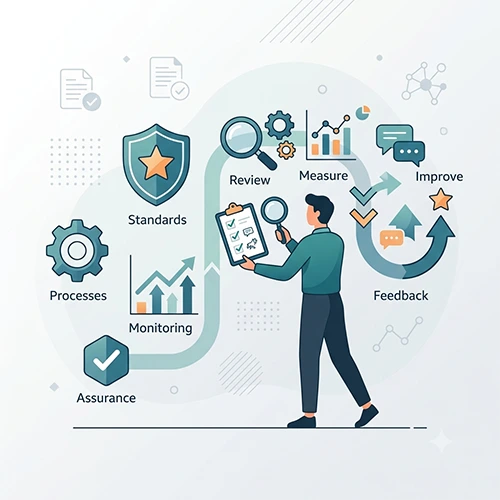


Understanding Internal Quality Assurance
Behind every strong training programme is quality assurance.
When learners are being assessed, there must be systems in place to ensure those assessments are:
- fair
- accurate
- consistent
- professionally sound
This is where the Internal Quality Assurer (IQA) plays an essential role.
The IQA helps maintain standards, supports assessors, and ensures assessment decisions are reliable.
For many professionals already working in teaching or assessment, Internal Quality Assurance represents the natural next progression step.
This guide explains:
- what an IQA does
- what responsibilities the role involves
- who the qualification is for
- career opportunities available
- whether this is the right progression route for you
What Is an IQA?
IQA stands for:
Internal Quality Assurance
An Internal Quality Assurer is responsible for monitoring and maintaining the quality of assessment processes within an organisation.
Their role is to ensure that assessors are making fair, consistent and accurate assessment decisions.
This helps maintain the integrity of qualifications and protects learners.
Why Is Internal Quality Assurance Important?
Assessment decisions must be trustworthy.
If assessment standards vary between assessors, learners may receive inconsistent outcomes.
Internal Quality Assurance helps prevent this.
It ensures that:
- assessment decisions are standardised
- learners are assessed fairly
- assessors receive support
- qualification standards are maintained
Without effective IQA processes, training quality can quickly become inconsistent.
What Does the IQA Role Involve?
An Internal Quality Assurer has several important responsibilities.
1. Sampling Assessment Decisions
One of the core IQA responsibilities is reviewing learner assessments completed by assessors.
This involves checking that assessment decisions are:
- valid
- consistent
- evidence-based
- aligned with qualification standards
2. Supporting Assessors
IQA professionals provide guidance to assessors.
This may include:
- professional feedback
- clarification of standards
- improvement recommendations
- support with consistency
A strong IQA helps strengthen assessor confidence and performance.
3. Monitoring Assessment Practice
IQA professionals review how assessment is being conducted.
This may involve checking:
- assessment planning
- observation processes
- evidence review procedures
- learner feedback quality
4. Maintaining Standardisation
Consistency is essential.
The IQA helps ensure that all assessors apply standards consistently.
5. Supporting Quality Improvement
An IQA helps identify areas where assessment systems can improve.
This supports stronger training delivery overall.
Who Should Obtain an IQA Qualification?
The IQA qualification is ideal for professionals who already have assessment or teaching experience.
It is particularly suited to:
Qualified Assessors
Professionals already making assessment decisions.
Experienced Trainers
Those progressing into broader quality responsibilities.
Internal Verifiers
Professionals moving into formal quality assurance roles.
Education Professionals Seeking Progression
Those aiming for leadership within vocational training.
What Qualification Do You Need?
The recognised route is the:
Level 4 Award in Internal Quality Assurance of Assessment Processes and Practice
This qualification develops the knowledge and practical skills required to perform the IQA role effectively.
What Is the Level 4 IQA Course Content?
The qualification typically covers:
- internal quality assurance principles
- sampling strategies
- standardisation processes
- supporting assessors
- monitoring assessment quality
- quality assurance planning
- maintaining consistency
The focus is highly practical and professionally applied.
Do You Need CAVA Before IQA?
Not always formally.
However, assessment experience is strongly recommended.
Most learners benefit from first completing:
👉 Level 3 CAVA
This provides valuable assessment understanding before progressing into quality assurance.
How Long Does the IQA Course Take?
Typical completion time:
8–16 weeks
This depends on:
- delivery format
- workplace access
- learner pace
Flexible online delivery allows most learners to study alongside work.
Is IQA Challenging?
The course is manageable for learners with assessment experience.
The main challenge is understanding quality assurance systems and applying consistency principles effectively.
Success depends on:
- professional understanding
- engagement
- structured study
What Career Opportunities Does IQA Create?
The qualification can lead to roles such as:
- Internal Quality Assurer
- Internal Verifier
- Lead Assessor
- Quality Coordinator
- Quality Assurance Lead
- Programme Quality Manager
It opens progression into broader educational leadership roles.
Salary Expectations
Typical UK salary ranges include:
Entry-Level IQA Roles
£35,000–£42,000
Experienced IQA Professionals
£42,000–£50,000+
Senior Quality Leadership Roles
£50,000+
This reflects the increased responsibility and oversight involved.
How IQA Fits Into Professional Career Progression
A common progression route is:
Step 1
AET
Learn to teach
↓
Step 2
CAVA
Learn to assess
↓
Step 3
IQA
Monitor assessment quality
↓
Step 4
Leadership / Programme Management
This creates a structured pathway into senior vocational education roles.
Why Professionals Progress Into IQA
Many experienced assessors eventually seek broader responsibility.
IQA offers:
- professional progression
- greater strategic involvement
- leadership opportunities
- wider influence on quality standards
It is often the next logical step.
Common Mistakes to Avoid
Taking IQA Too Early
Assessment experience provides essential context.
Choosing Providers Without Practical Support
Clear structure matters.
Underestimating Quality Assurance Complexity
IQA involves thoughtful professional judgement.
Is the IQA Qualification Worthwhile?
For professionals seeking progression beyond assessing, absolutely.
It offers:
- recognised progression
- increased responsibility
- stronger career opportunities
- leadership development
Why Choose Trainigo?
At Trainigo, IQA is delivered as part of a connected professional progression pathway.
We help learners understand:
- when IQA is appropriate
- how it connects to CAVA
- where it can lead professionally
Our learners benefit from:
- flexible online delivery
- structured support
- practical guidance
- progression-focused learning
Frequently Asked Questions
What does IQA stand for?
Internal Quality Assurance.
What does an IQA do?
An IQA monitors assessment quality and supports assessors.
Do I need to be an assessor first?
Assessment experience is strongly recommended.
Is IQA recognised in the UK?
Yes.
It is a recognised quality assurance qualification.
How long does it take?
Most learners complete within 8–16 weeks.
Final Thoughts
Internal Quality Assurance is one of the most valuable progression routes within vocational education.
It allows professionals to move beyond assessing and into roles focused on standards, consistency, and quality leadership.
For experienced assessors looking to progress professionally, IQA is often the clearest next step.
Ready to Progress Beyond Assessing?
Take the next step into quality assurance leadership.
Not Just Courses. Career Pathways.
Trainigo provides structured routes into professional progression — helping learners understand what to do, when to do it, and how to move forward with confidence.